
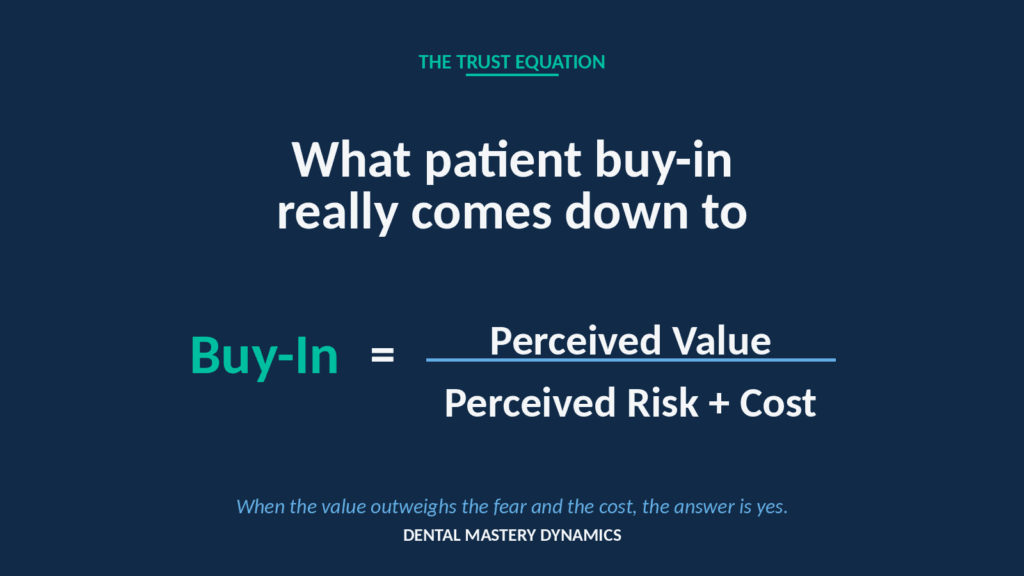
Why does one patient say yes to a full treatment plan while another patient with the same diagnosis, the same doctor, and the same price walks out to “think about it”? Most teams chalk it up to the patient, their finances, their personality, their history. The truth is less mysterious and far more useful. Patient buy-in follows an equation, and once your team understands it, every moment of the visit becomes a chance to move the math in the right direction.
We call it the trust equation, and it looks like this: buy-in equals perceived value over perceived risk plus cost. The whole visit, from the first phone call to the final signature, is spent making the top of that fraction bigger or the bottom smaller. Here is how it works, and how your team can start working it on purpose!
What is the trust equation for patient buy-in?
The trust equation says a patient’s buy-in equals their perceived value divided by their perceived risk plus the cost. When the value a patient feels outweighs the risk they fear and the price they will pay, they say yes. When it does not, they hesitate, defer, or walk.
Notice the word perceived doing the heavy lifting on both sides. The clinical reality of the treatment matters, but the decision gets made on what the patient feels the treatment is worth and what they fear it will cost them, in money, in pain, in judgment. Your team cannot change the diagnosis. They can absolutely change the perception, and that is the entire job.
The denominator has two parts, and they behave differently. Perceived risk is everything the patient is afraid of: the pain, the needles, the fear of being judged for how long they waited, the fear of the unknown. Cost is its own term, and it is the one piece your financial team directly controls, yet often the most fixed. That split matters, because it tells you who can move what. The clinical team spends the visit raising value and lowering risk. The person running the consult works the cost.
How do you raise a patient’s perceived value?
Perceived value comes in two forms: the value of the work itself, and the value of the experience surrounding it. Both count, and the second one is bigger than most teams think.
The value of the work is what the treatment saves the patient down the road, in money, in pain, in time. The single most useful line a team member can internalize is this: your dental work will never be cheaper than it is right now. The longer a patient waits, the more severe the problem gets, the more painful it gets, and the more costly it gets.
Clinicians are often reluctant to talk numbers, and they do not have to quote exact fees to make this real. Ballparks work. A filling runs a few hundred dollars. Wait, and the decay deepens until that filling becomes a crown, which runs closer to fifteen hundred. Keep waiting, and the crown needs a root canal first, another fifteen hundred. The same tooth went from a few hundred dollars to several thousand because nothing was done. Framed that way, treatment stops being an expense and becomes what it actually is: spending a little now to save a lot later.
Why does the office experience change what patients accept?
Because patients are human, and humans buy where they feel at home. The second form of perceived value is the ambiance, the warmth of the greeting, the feeling that the office is welcoming and unhurried, the sense that the people there see you as a person and not a chart number.
A story that makes it concrete. A family member of mine needed an implant and asked me, as the dental professional in the family, for a recommendation. I knew a dentist near him I would trust with my own work, and I sent him there. He went, got his exam, got a fair quote. And then he kept looking anyway. He ended up choosing a different office entirely, not because the price was better or the dentistry was better, but because the moment he walked in, he felt at home. The environment was warm, everyone was welcoming, and that feeling raised the value of everything they offered him. My professional recommendation lost to their waiting room.
Here is the part that makes the experience so powerful in the equation: it moves both numbers at once. A patient who feels at home does not only value the office more, they trust it more, and trust shrinks perceived risk. The fear of being judged fades, the fear of the unknown fades, and the same treatment plan that felt intimidating somewhere else feels manageable here. One improvement, two levers.
How do you lower perceived risk?
Lowering risk is the faster half of patient buy-in. Start with the two fears nearly every patient carries: the fear of cost and the fear of the anesthetic needle. You can attack both before the patient ever names them, and doing so builds trust fast, because you are solving problems they were silently bracing for.
The clearest example is condensing treatment into as few visits as clinically appropriate. Fewer visits means fewer injections, and telling a patient “I can get you fewer shots” lands almost universally. It also means fewer chances for life to get in the way, fewer appointments to keep, fewer opportunities for a no-show or an emergency to derail the plan. Beyond that, risk falls every time the patient understands what is happening and why. People fear what they do not understand, which is why the presentation work we covered in the SIR method matters so much: a patient who has seen their own condition and understands the fix carries far less fear into the consult.
Why does the trust equation have to be built across the whole visit?
Because patient buy-in is the sum of every moment of the visit, each one feeding one side of the fraction or the other, whether your team is doing it on purpose or not. The equation starts moving the instant the patient searches for your office online, and it keeps moving through the phone call, the greeting, the hygiene chair, the doctor’s exam, and the handoff.
It is also fragile. A patient can come in on a Monday trusting the office completely, and the same patient on a Tuesday, greeted by a team member having a rough morning, can leave without accepting a thing. Every touchpoint either builds the fraction or erodes it, which is why patient buy-in is a whole-team responsibility and not a consult-room skill.
By the time the patient sits down for the money conversation, most of the equation is already set. The consult is not where value gets built, it is where you find out whether it was built. If a patient is pushing back hard at the end, the fraction tipped somewhere upstream, and you are in recovery mode, which we covered in how to recover a no. The goal is to never need it.
What is the consult’s real lever in the equation?
Cost. The person running the consult is usually not someone the patient will see chairside at every visit, so their influence on perceived value and perceived risk is limited. What they do control is the third term, and the way they present it can shrink how big the cost feels without changing the price at all.
The move is to make the cost feel smaller by breaking the number down, never the treatment. An eight thousand dollar plan, presented through third-party financing, becomes around two hundred dollars a month. Break it down further and it is a handful of dollars a day, the cost of a coffee run. Make your coffee at home for a couple of years and the treatment pays for itself. The last number in the patient’s head should be the one they can picture living with, not the lump sum.
One boundary that cannot be crossed: you chunk the payment, never the plan. Presenting treatment piece by piece invites the patient to shop their own care a la carte, which serves nobody, least of all the patient. The full mechanics of when and how the money conversation happens live in our pillar post on the five steps of a dental consult, where the rule is simple: the plan stays whole, the payment gets bite-sized, and the patient is the one who brings up money first.
Bringing it together
Patient buy-in is not a personality trait and it is not luck. It is a fraction: perceived value over perceived risk plus cost, and every person in the building moves it. The clinical team raises value with urgency, education, and an experience that makes people feel at home. Everyone lowers risk by shrinking the fears patients carry in with them. And the consult shrinks how the cost feels, without ever splitting the care. Teach your team the trust equation and the question stops being “why did that patient say no?” It becomes “where did the fraction tip?”, and that question always has an answer you can fix!
Frequently Asked Questions
What is the trust equation in dentistry?
The trust equation says patient buy-in equals perceived value divided by perceived risk plus cost. When the value a patient feels outweighs their fears and the price, they accept treatment. Every part of the visit moves one side of that fraction.
How do you increase patient buy-in for treatment?
Raise perceived value and lower perceived risk across the whole visit. Show what treatment saves in future cost and pain, make the office feel welcoming, condense care into fewer visits, and educate so the patient understands the why. Buy-in is built long before the money conversation.
Why do patients refuse treatment even when they need it?
Because their perceived risk plus the cost outweighs the value they feel. The fears are usually cost, pain, needles, or judgment. When treatment feels expensive, scary, or poorly understood, the fraction tips toward no, regardless of clinical need.
How should cost be presented to improve patient buy-in?
Break down the payment, never the treatment. A large plan presented through monthly financing becomes a number the patient can picture living with, a couple hundred a month instead of thousands at once. The care plan stays whole while the cost gets bite-sized.
Does the office environment really affect case acceptance?
Significantly. Patients choose where they feel at home, sometimes over a better-credentialed recommendation. A warm, welcoming experience raises perceived value and lowers perceived risk at the same time, because a patient who trusts the office fears the treatment less.