
Most case acceptance problems do not start at the front desk. They start in the chair, in the few minutes after a doctor finds something and before the patient ever hears a number. Handle those minutes well and the rest of the visit gets easier. Handle them poorly and your treatment coordinator inherits a patient who has no idea why they are being asked to spend money.
The SIR method is how we teach practices to use those minutes. It is built on three steps, and once a clinical team runs it consistently, the conversations at the front desk change within weeks.
What is the SIR Method in dentistry?
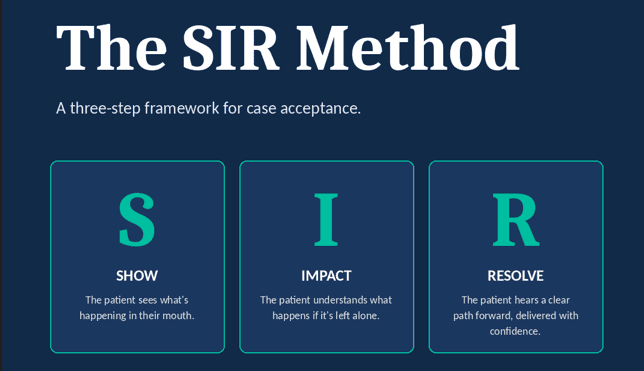
The SIR method is a chairside case presentation framework built on three steps: Show, Impact, and Resolve. It moves a patient toward affirming the treatment plan while they are still in the chair, before they reach the treatment coordinator and before cost enters the conversation.
The idea is simple. The person who diagnosed the problem is the person the patient trusts most in that moment. The SIR method gives the provider a repeatable way to use that trust, so the patient understands what is wrong, why it matters, and what happens next before anyone talks money.
Why does case acceptance break down before the treatment coordinator?
Case acceptance usually breaks down because the patient reaches the front desk without ever understanding what is wrong or why it matters. When a coordinator presents a number to a patient who cannot see the problem and does not feel it, the answer is almost always some version of “let me think about it.”
This is not a coordinator problem. It is a handoff problem. A coordinator who is handed a cold patient is set up to fail no matter how good they are. We have written before about why case acceptance stays flat and about how presentation depth drives profitability. The SIR method is the in-chair piece that makes both of those work, because it warms the patient up before the conversation about treatment ever moves to the front.
What does “Show” mean in the SIR Method?
Show means letting the patient see the problem with their own eyes in full color, not only hearing about it or looking at a film they cannot read. A radiograph on its own is not enough. There should always be a full-color version of the problem in front of the patient, whether that is the mirror with the provider pointing to it, an intraoral scan, or an intraoral photo.
A patient who is told they have a fractured cusp has to take your word for it. A patient looking at a clear, full-color image of their own fractured cusp is already halfway to understanding why it needs attention. Use the intraoral camera or scanner, or hand the patient the mirror and point. A radiograph can add real weight when the provider walks the patient through it, showing where the bone should sit against where it actually is, but a film handed across the room without that interpretation keeps the problem abstract. The goal is for the patient to leave the Show step able to point at the problem themselves.
Here is what that looks like in practice. A patient comes in checked out, the kind who is there because they feel they have to be and is not committed to anything. The doctor pulls up the 3D scan and shows it to them in full color, and the room changes in a second. The patient leans in and starts asking questions about what they are seeing. You have moved them from “I am only here because I have to be” to “what is that, and how do I fix it.” That shift is the entire reason the Show step comes first.
How do you explain the Impact without scaring the patient?
Impact means connecting the problem to the patient’s life, not only to the tooth. You explain in plain language what happens if it goes untreated, and you tie it to something they actually care about, like chewing without pain, keeping the natural tooth, or avoiding a larger procedure down the road.
There are two ways worth framing this. The first is the financial reality of waiting. A filling done now might not even hurt yet, but left alone it can get deep enough to need a root canal and a crown. That is the difference between a couple hundred dollars today and several thousand later, and the patient is in real pain while they spend it. Patients understand that tradeoff immediately when you lay it out plainly.
The second is timing. Dental problems do not stay quiet. They end up hurting, and once a patient waits until it hurts to act, the window for the smaller fix has usually closed. One line that lands well with patients sums it up: your dental work will never be cheaper, and the condition will never be less painful, than it is right now.
None of this is about fear. It is about honesty. A patient has the right to understand the cost of doing nothing, and most of the time that cost is gradual rather than dramatic. Said calmly and without jargon, that is information a patient needs to make a real decision. Said with pressure, it backfires. The line between the two is tone, and tone is something a team can practice.
What does “Resolve” mean, and how does it set up the handoff?
Resolve means giving the patient a clear, confident path forward and a single next step. The provider states the recommended treatment plainly, answers the patient’s questions, and hands them to the team already believing in the plan, so the coordinator handles logistics rather than selling.
By the time a patient reaches the front desk after a good Resolve step, they have affirmed the plan two or three times already. The coordinator is no longer convincing anyone. They are arranging timing and payment for a patient who has decided. That is the entire point of the chairside work. It changes the coordinator’s job from persuasion to coordination, which is a job almost any team member can do well once the trust has already been built.
Why does the SIR Method actually work?
The SIR method works because it changes the math in the patient’s head before cost is ever mentioned. Treatment acceptance comes down to perceived value divided by perceived risk plus perceived cost, and SIR raises value while lowering risk before the cost side of that equation is even on the table.
Show raises perceived value, because a problem you can see feels worth solving. Impact raises it further, because now the patient understands the stakes. Resolve lowers perceived risk, because the patient has a clear and safe path forward instead of an open-ended worry. So when cost finally enters the conversation at the front desk, the denominator is already smaller and the number lands very differently than it would have if the same patient had walked straight from the chair to a quote.
How do you start using the SIR Method tomorrow?
You start by aligning the clinical team on the three steps and practicing them out loud before using them with patients. Changing how a team presents takes rehearsal, so the first move is a conversation in your morning huddle and a short role-playing session, not a memo.
- Make a full-color photo or scan part of every significant finding, so the Show step is never skipped.
- Have the provider name the impact in the patient’s own terms before leaving the operatory.
- End every chairside visit with a clear recommendation and a single next step, so the patient is handed off warm.
- Watch what happens at the front desk over the next few weeks. The shift from “let me think about it” to scheduling is the signal that the framework is landing.
Inspect what you expect. A framework that lives in a binder does nothing. A framework the team runs every visit, and that leadership actually watches for, is what moves treatment acceptance. If you want the one-page version of this to share with your team, we put together a free SIR method breakdown you can download here.
Bringing it together
The practices with the strongest treatment acceptance are rarely the ones with the best closers at the front desk. They are the ones where the patient already understood and believed in the plan before they ever stood up from the chair. The SIR method is how you build that consistently, visit after visit, instead of leaving it to whichever provider happens to be naturally good at it.
At Dental Mastery Dynamics, this is the kind of operational detail our platform helps teams stay accountable to every day. If you want to see how daily coaching keeps frameworks like this from fading after the first good week, take a look at our solutions and pricing.
Frequently Asked Questions
What does SIR stand for in the SIR method?
SIR stands for Show, Impact, and Resolve. It is a chairside case presentation framework that helps a patient understand what is wrong, why it matters, and what happens next before they reach the treatment coordinator.
Is the SIR method only for the dentist?
No. The doctor leads the SIR conversation for restorative findings, but hygienists and other clinical team members use the same Show, Impact, and Resolve structure for the findings within their scope. The framework works for any role that diagnoses or explains a finding chairside.
How is the SIR method different from a sales script?
A sales script focuses on closing. The SIR method focuses on understanding. It raises the patient’s perceived value and lowers perceived risk by showing them the problem and explaining its impact honestly, so the decision is informed rather than pressured.
Does the SIR method work for periodontal treatment?
Yes, and periodontal therapy is one of the clearest places it helps, because patients often cannot feel gum disease in its earlier stages. Show the full-color intraoral photos of the inflamed tissue, and then use the radiograph, which for perio can be genuinely powerful. Point to where the bone should sit, at the base of the enamel, and contrast it with where the bone actually is. If calculus wings are visible, they make the point on their own.
A simple way to put it: those pointy bumps are bacterial colonies that have hardened into what we call calculus, and the colony has gotten so large that the X-ray, a device built to detect bone, is reading the bacteria on the teeth as bone. Between the color photos and the radiograph, an invisible problem becomes one the patient can see and act on.
How much time does the SIR method add to an appointment?
Very little. Done well, the three steps add a minute or two in the operatory and save far more time at the front desk, because the patient arrives ready to schedule rather than needing to be convinced.