
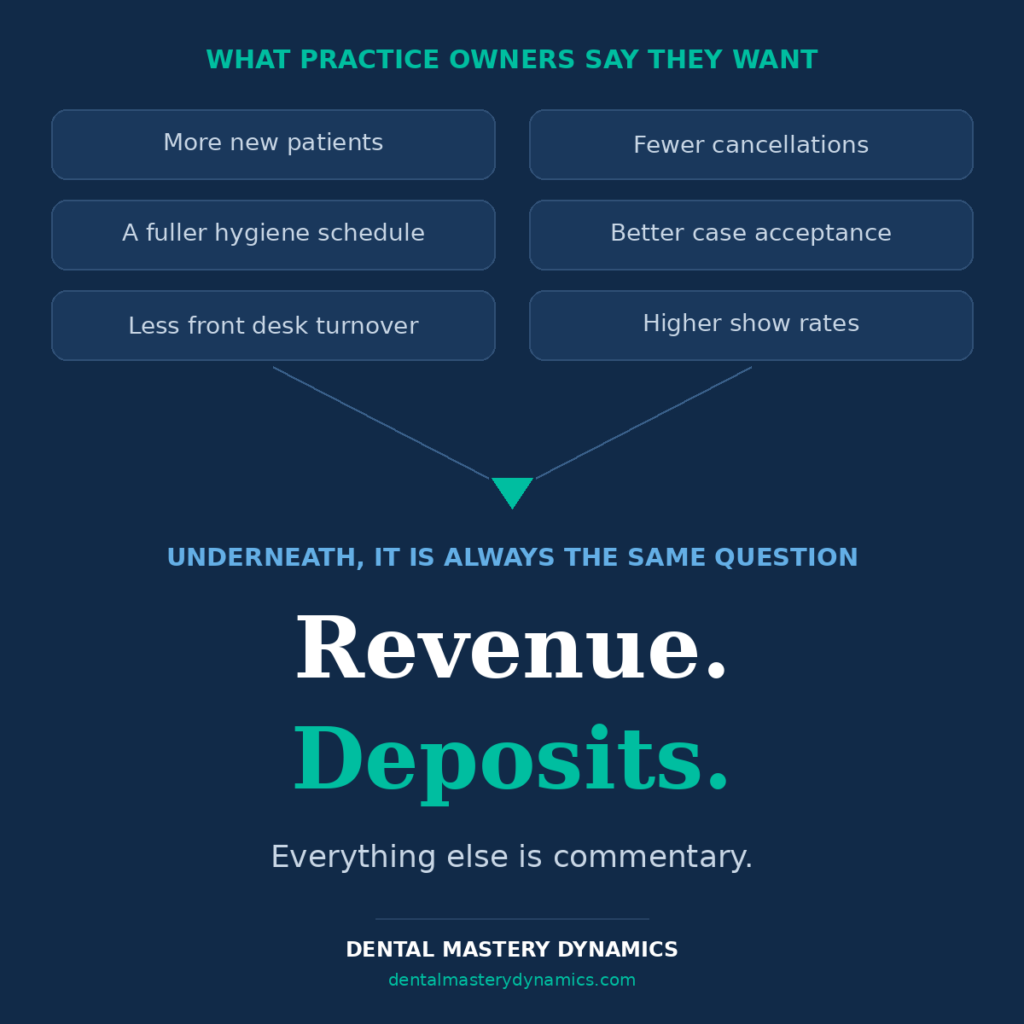
Dental practice profitability comes down to two numbers, and neither one is on the list of things owners usually ask me about. Owners ask how to get more new patients. They ask how to stop cancellations, how to keep the hygiene schedule full, how to handle a front desk that keeps turning over. Every one of those questions is real, and every one of them is a costume worn by the same underlying question: why is my bank account not where I need it to be?
What Two Numbers Actually Decide Dental Practice Profitability?
What you earned and what you collected. Revenue and deposits. After two decades running dental operations, I have never found a third number that belongs in that sentence. Everything else on the dashboard, show rate, case acceptance, presentation depth, schedule utilization, exists to explain those two numbers. The supporting metrics are behaviors and diagnostics. They tell you how you arrived at the result. They are not the result.
Here is the test. A practice runs one hundred percent case acceptance and produces one hundred dollars. Perfect score on the metric everyone chases, and no dental practice profitability to show for it, because nobody keeps the doors open on a hundred dollars. Acceptance was never the goal. It was one of several paths to the goal, and a practice can polish any single path to a shine while the destination stays out of reach.
The supporting numbers still matter enormously, and I want to be precise about why. When the two numbers disappoint, the drivers underneath are how you find the cause. Weak revenue might be a demand problem, a presentation problem, or a team problem, and the diagnostic metrics are how you tell those apart instead of guessing.
How you got there matters. What you got to matters most, because the bank account is the number an owner actually feels. A full account convinces an owner nothing needs to change, which quietly protects whatever is broken. An empty one makes them want to change everything at once, including the parts that work.
Reading the two numbers alongside their drivers, instead of by gut, is the discipline that protects dental practice profitability from both mistakes. I wrote about the collection side of that discipline in how to grow revenue without adding a single patient.
Why Is “How Do I Get More New Patients” Really a Profitability Question?
Because the owner asking it is almost never short on patients. They are short on revenue, and new patients are the most familiar lever within reach. Decode the request and it reads: my earnings are not where they need to be, and I want more chances to fix that. Once you hear it that way, marketing becomes one option among several instead of the reflex answer. It also happens to be the most expensive option and the slowest one.
The timelines here are documented, not consultant folklore. Even paid search, the fastest channel available, typically needs two to three months before preliminary results confirm the strategy is on track, with significant results taking up to a year. Organic search is slower still, with six to twelve months as the general window before SEO produces concrete results.
So the owner who needs revenue this quarter and reaches for a marketing budget has ordered a solution that arrives next quarter at the earliest. The honest question for dental practice profitability in the next ninety days is different: how do we fully capitalize on the patients already coming in with what we already have, while any new marketing ramps up behind it?
There is also a marketing engine hiding inside that question. Patients who are treated the right way, educated about their care, and moved through a practice that runs well refer their friends and family. Doing right by the patients already in your chairs grows demand on its own, and it costs nothing.
Which Four Levers Hide the Money?
When dental practice profitability feels underwater despite a decent schedule, I look at four things in order of what the data shows me, not in a fixed sequence.
First, presented versus accepted. How much treatment is being presented to each patient walking in, and how much of it gets accepted? Average treatment presented per patient, average treatment accepted value, and the gap between them tell you whether the problem lives in diagnosis depth or in the conversation. Shallow presentation caps everything downstream, which is why when money enters the conversation matters as much as what gets said.
Second, overall case acceptance percentage. What share of patients say yes at all?
Third, and this one deserves more respect than it gets, new patient show rate. A practice calls me convinced their marketing died. The numbers say scheduled new patients held steady while arrivals fell. Nothing happened to demand. A confirmation call or a welcome call quietly fell out of the routine, and fewer of the patients already booked ever reached the chair. A behavior breakdown wearing a marketing costume, and it fools owners constantly.
Fourth, the percentage of accepted treatment actually completed within sixty days of presentation. This is the quiet killer, and accrual accounting explains why. Revenue does not book when a patient says yes. It books when the work is performed.
A signed treatment plan that never reaches the chair was never revenue at all. The practice did everything hard, diagnosed the condition, presented it well, earned the yes, and then let the entire value evaporate at the scheduling step. Nothing touches the earned line, so nothing can ever reach the deposit line, and dental practice profitability absorbs the loss without anyone noticing.
Which Dental Practice Profitability Lever Should You Fix First?
The broken one. I wish there were a universal answer, but the honest one is that the levers vary by office. Some practices present beautifully and lose patients at the front door. Some fill every chair and present eight hundred dollars to patients who needed comprehensive care. The diagnosis tells you where to start, which is itself the whole argument for measuring all four instead of picking a favorite.
One pattern does hold: the four levers rarely all break at once, and when they have, the failure usually cascaded from the first one.
So find the highest broken lever and work down. If acceptance is strong and show rate is weak, work the show rate. If patients show reliably and acceptance sags, work the presentation, and the SIR Method is the framework I teach for exactly that conversation.
How Do You Get Accepted Treatment Actually Completed?
I flagged completion as the quiet killer, so here is the playbook that moves it, because getting the yes is one achievement and getting the patient physically back in the chair is another.
Collect a deposit at the consult. Plenty of offices resist this because it feels corporate, and the pushback you fear mostly never comes. When a patient does hesitate, I offer a comparison: when you book a flight, do you pay when you buy the ticket or when you land?
Then make sure the patient knows the deposit is fully refundable if they cancel, which removes the fear from the ask on both sides of the desk. The real purpose is schedule protection. A reserved surgical block that a patient skips was a spot another patient needed, and a deposit gives the patient skin in the game to show up.
Keep the deposit amount flexible, because rigidity here costs real money. A large group I ran operations in required sixty percent down, held so firmly that offices declined patients offering ten thousand dollars on a twenty thousand dollar plan because the final two thousand was out of reach that day.
I changed that expectation for my offices. I aimed for fifty percent and accepted less whenever the amount was still significant enough that the patient would not forget they spent it. Five hundred dollars can do the job. On a four hundred dollar procedure, two hundred does it. Significance to the patient is the standard, because that is what retains them.
Build urgency honestly. State plainly what waiting costs: the condition progresses, and the version of this procedure six months from now is more expensive and less comfortable than the version available today. That is a factual statement about how dentistry works, delivered in the certainty language the SIR framework requires.
Do as much as possible the day the patient is already in the building. The show rate of a patient sitting in your chair who said yes is one hundred percent. The moment they walk out the door it drops, and it keeps dropping with every day between the yes and the appointment. Same day dentistry is not a scheduling trick. It is the mathematically safest moment to complete care.
And close the net with process. Audit charts before each visit so that when a patient arrives for one procedure, someone has already noticed the unscheduled next steps sitting in their plan and gets them booked before they leave. Review those catches in morning huddle so the whole team walks in knowing which patients need the conversation today.
How Is This Principle Built Into Dental Coach AI?
This decoding habit, hearing the dental practice profitability question underneath the surface question, is the operating principle Dental Coach AI was built around. Ask it for more new patients and it does the diagnostic an operations leader would do. It reads the numbers it synced from your practice management system overnight, tells you whether new patient flow is genuinely the constraint, and shows you what else is sitting in the four levers of dental practice profitability while any marketing decision plays out.
The answer we designed it to give is the one I gave owners for years: we can work on your new patient flow, and here is how, and in the meantime the lift you are looking for is probably already here. It needs to be captured, not purchased.
That is what the first ninety days of coaching are largely spent doing: finding which lever is broken in your specific practice and building the daily behaviors that fix it. If you want that diagnosis run on your own numbers, the strategy call is where it starts. The August intake is open through the 31st, every practice that joins this month gets onboarded directly by me, and the calendar is here. Bring the question you have been asking. We will find the one underneath it.