
A practice owner opens ChatGPT and asks how to bring in more new patients. It is the most common question in dentistry, and it is almost never the real one. Underneath it sits a different question: how do I drive more revenue. Ask a generic AI the first question and it will happily answer the one you asked. Ask a coach, and the first thing they do is check whether you are capturing the patients you already have.
That gap is the whole difference between a general tool like ChatGPT or Claude and a coach built for dental operations. The real question behind using ChatGPT for dental practices is not whether it is smart, because it is. It is whether a general tool is built to run your operations, and it is not. The technology is genuinely impressive. This is about what each one is actually designed to do.
Can ChatGPT for dental practices actually run your operations?
Yes, to a point. ChatGPT and Claude are both capable, and if you paste in your numbers and ask a sharp question, they will give you a thoughtful answer. The limits show up in what they cannot see and what they are built to do.
A general model has no standing access to your practice. It does not know your numbers from yesterday, it cannot pull a report on its own, and it forgets the conversation once you close the window. It is built to respond to whatever you type in the moment, not to watch your operations day after day. That makes it a strong assistant for a one-off question and a poor fit for the ongoing job of running a practice, where the value is in noticing the pattern before it becomes a bad month.
What do ChatGPT and Claude get wrong about dental operations?
The biggest blind spot is that a generic AI answers the question you ask instead of the question behind it. When an owner asks how to get more patients, ChatGPT or Claude returns a list of marketing ideas, because that is what was asked. The advice is usually fine. It simply assumes the premise of the question is correct.
Here is where that goes wrong in a real practice. Say three new patients show up every day. On the surface that looks healthy, so a generic AI, handed that detail, will tell you that you are doing well and suggest ways to get a fourth. But look closer at those three. One accepts the comprehensive plan the doctor recommended. One accepts only the cheap chief-complaint fix and leaves the rest on the table. The third does not accept anything at all. You did not have a new-patient problem. You had an acceptance problem, and you were about to spend money attracting more patients into the same leak.
The owner asked about patients. The real question was revenue, because it almost always is. A generic model takes the question at face value and answers it well. A coach, human or specialized AI, stops and asks what the numbers are actually saying before answering, because more demand poured into a practice that leaks production at the show rate, the handoff, or the front desk does not fix anything. It just makes the leak more expensive. We have written about the two places revenue most often disappears, in new patient show rate and in the handful of KPIs that actually control profitability.
Why does generic AI tell you what you want to hear?
Because that is largely what it is built to do. Models like ChatGPT and Claude are trained to be helpful and agreeable to the person typing, so they tend to validate your framing before they ever question it. Tell one your plan and it will often open by telling you what a smart plan it is.
That feels good in the moment and it is the opposite of coaching. A real operations coach is willing to tell you the uncomfortable thing: that the slow day was not bad luck, that the schedule looked full but produced nothing, that the problem you brought is not the problem you have. Generic AI rarely pushes back unprompted, because it has no stake in your outcome and no context for what good actually looks like in your practice. It is designed to make you feel capable. A coach is designed to make you more profitable, and those are not always the same conversation.
What happens when you put the same numbers in front of each one?
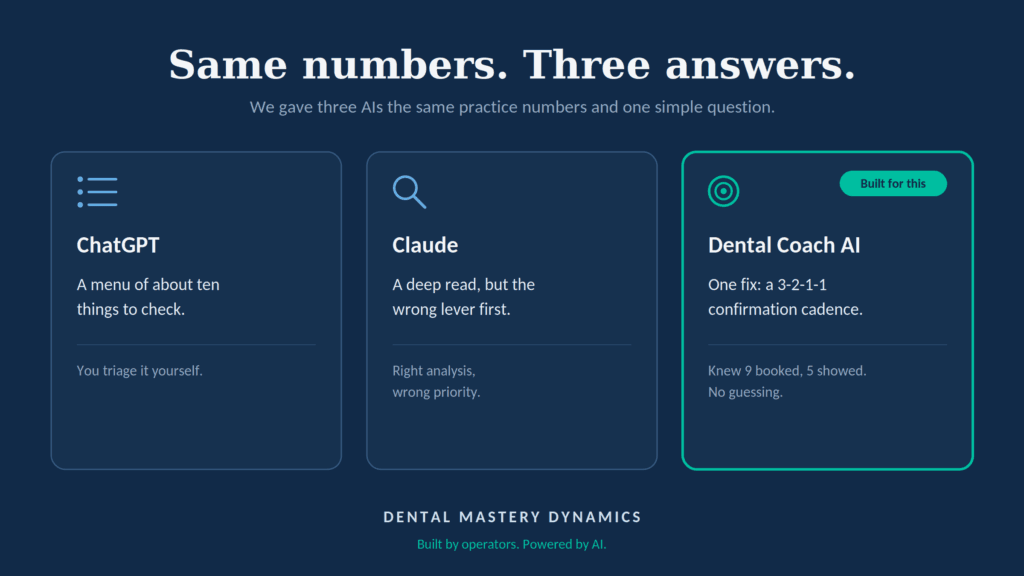
We ran the test. We gave ChatGPT, Claude, and our own Dental Coach AI the same day of practice data and the same question about why a day that looked fine had felt slow. All three are capable, and the difference was not intelligence. It was focus.
ChatGPT returned a thorough breakdown and then a menu of roughly ten things to look at, organized into key signals, likely causes, and high-impact fixes. Confirmation systems, a same-day call list, reserving flexible blocks, deposits, front-desk training, the works. Every item was reasonable. But the owner is left holding a checklist and no sense of which item would actually have saved that day, which is its own kind of paralysis.
Claude went deeper and got closer. It correctly flagged that revenue was logged at zero against four thousand dollars collected, and it caught the show rate. But it led with the existing-patient count and the schedule-utilization figure, calling the empty schedule the most telling metric, when that zero was most likely a data-entry artifact. It analyzed well and still pointed at the wrong lever first, which is exactly the kind of mistake that sends a team chasing the wrong fix for a week.
The Dental Coach AI zeroed in. It said the day felt slow because nine new patients were scheduled and only five showed, a 56 percent show rate, and it gave one practical change to make: a 3-2-1-1 confirmation cadence the team could run the very next morning. One problem, one fix, ready to act on. No menu to triage, no wrong lever, no homework.
The most revealing detail is small. ChatGPT and Claude both had to guess how many new patients were scheduled, because they only knew what was pasted into the box. One guessed ten, the other hedged that there were probably more than the five who arrived. The Dental Coach AI did not guess. It is connected to the practice management system, so it worked from the real number, nine. When the foundation of the answer is a guess, everything built on top of it is built on sand, no matter how articulate it sounds.
What can a specialized dental AI do that ChatGPT and Claude cannot?
It connects to your practice management system, so it works from your real numbers instead of a snapshot you happened to paste in. And it is built on dental operations experience, so it knows which number is the lever and which is noise.
- It works from the truth. Connected to your system, it reads what actually happened rather than what you remembered to type, so it never has to guess at the number that anchors the whole answer.
- It prioritizes. Instead of a menu to triage yourself, it surfaces the one change that moves the day, because it understands which metric drives the others.
- It is specific. A named protocol your team can run tomorrow, not a general principle you still have to translate into an action.
- It is proactive. It reads the numbers every morning, so it catches the slow day before you even feel it, rather than waiting for you to notice something is off and think to ask.
Underneath all of that, the Dental Coach AI is built on more than 25 years of hands-on dental operations experience, encoded into the platform. That is the part a general model cannot match, because that experience does not live in a search engine or a generic training set. It is why the platform reads a 56 percent show rate as a story about a broken confirmation process rather than as one more number in a table, and why it knows that a strong-looking new-patient count can still hide a revenue problem. The same instinct applies to case acceptance, which we break down in the SIR method.
What would it take to get the right answer out of ChatGPT anyway?
You could get close, but look at everything you would have to do first. You would have to already suspect there was a problem, know which report to pull, export the right numbers, paste them in cleanly, and ask a precise enough question to point the model at the real issue. In other words, you would have to do most of the diagnostic work yourself before the AI ever weighed in.
And even then, it would fill any gap you left with a guess, it would not necessarily prioritize the way an experienced operator would, and it would have no memory of the conversation tomorrow when the same pattern shows up again. The work an owner has to do to make a generic AI useful for operations is the work a specialized, connected coach removes. That is the whole point.
Should you stop using ChatGPT or Claude?
No. Both are genuinely useful general tools, and for drafting a flyer, rewriting an email, or thinking through a hiring post they are excellent. They are simply not built to run the operations of your practice.
The point is to use the right tool for the job. A general assistant for general tasks, and a connected, specialized coach for the numbers that decide whether your practice grows or quietly leaks. Generic AI answers the question you asked. A coach answers the question you actually have.
Bringing it together
Generic AI is impressive, and it is still blind to your practice, dependent on what you remember to ask, and never watching while you are busy with patients. A coach built for dental operations starts from your real numbers, finds the one lever that matters, and tells your team what to do about it today, then does it again tomorrow.
That is what Dental Mastery Dynamics was built to do. If you want to see the difference on your own numbers, take a look at our solutions and pricing.
Frequently Asked Questions
Can ChatGPT or Claude analyze my dental practice numbers?
They can, if you paste the numbers in and ask a specific question. But neither connects to your practice management system, so each one only knows what you give it and will guess at anything you leave out, which is exactly what happened when we tested them.
Is a specialized dental AI better than ChatGPT for running a practice?
For operations, yes. A specialized dental AI connects to your real data, prioritizes the one issue that matters instead of handing you a menu, and is built on dental operations experience a general model does not have.
Does Dental Coach AI replace ChatGPT or Claude?
No. They do different jobs. ChatGPT and Claude are strong general assistants for everyday tasks. Dental Coach AI is built to read your practice’s numbers every day and tell your team what to act on.
Why did three AIs give different answers to the same question?
All three were capable, but ChatGPT returned a long menu, Claude led with the wrong priority, and Dental Coach AI isolated the single highest-leverage fix. The difference was focus, and the fact that only the specialized AI was working from the practice’s real scheduled numbers rather than a guess.
Why does generic AI seem to agree with everything I say?
General models are trained to be helpful and agreeable to the person prompting them, so they tend to validate your framing before questioning it. Coaching requires the opposite: the willingness to tell you the problem you brought is not the problem you have.
Can AI really coach a dental practice?
General AI can advise when asked. Coaching is different. It means knowing your numbers, watching them daily, and telling the team the one thing to change, which requires both data access and dental operations experience built into the system.